Do Not Comply · AustraliaThink for yourself.Act with conscience.
Do Not Comply is an Australian website exploring critical thinking, personal responsibility and peaceful dissent. We examine institutional power and encourage readers to question claims, seek evidence and think for themselves.

Explore the ideas.
Start with a topic that interests you. Question the claims and follow the sources.
Independent judgement
Critical Thinking
How to test claims, recognise manipulation and strengthen independent judgement.
Money & institutions
The System
An examination of bank credit, housing, collateral and household debt in Australia.
Australia
Australian Debt Overview
A look at public and private borrowing across governments, households and businesses.
The aim of donotcomply.au is awareness.
Your conscience, judgement and responsibility belong to you. No institution deserves unquestioning trust. No authority gets to do your thinking for you.
Governments, media organisations, pharmaceutical companies, health authorities, central banks, universities and global institutions should all face difficult questions. Their decisions affect our lives. Their claims should withstand examination.
Ask for evidence. Look for conflicts of interest. Distinguish what is known from what is assumed. Test every claim—including the ones you read here.
Keep your judgement in your own hands.
Look closely at how fear, debt, convenience and social approval shape your choices. Something can become normal without becoming right.
Pause.
Give yourself room to think before fear, anger or urgency decides for you. A demanded response does not have to become an unexamined response.
Ask.
What is the evidence? Who benefits? What is being asked of you, and under what authority? Questions should be welcome.
Think.
Examine your own assumptions as closely as anyone else’s. Decide what would change your mind, and take responsibility for your conclusions.
Violence is not strength.
Do Not Comply means dignity without hatred, accountability without violence, and the discipline to stand firm without harming others.

Restraint is part of the message.
Anger, fear, frustration or political conviction do not excuse threats, intimidation or harm. Disagreement does not remove another person’s dignity.
Peaceful resistance requires discipline. Question decisions. Challenge claims. Make your case. Withdraw cooperation where lawful. Hold power to account without abandoning your own standards.
The way you act is part of what you stand for. Courage and conscience mean little if they disappear when a disagreement becomes difficult.
Stand firm. Stay peaceful. Take responsibility.
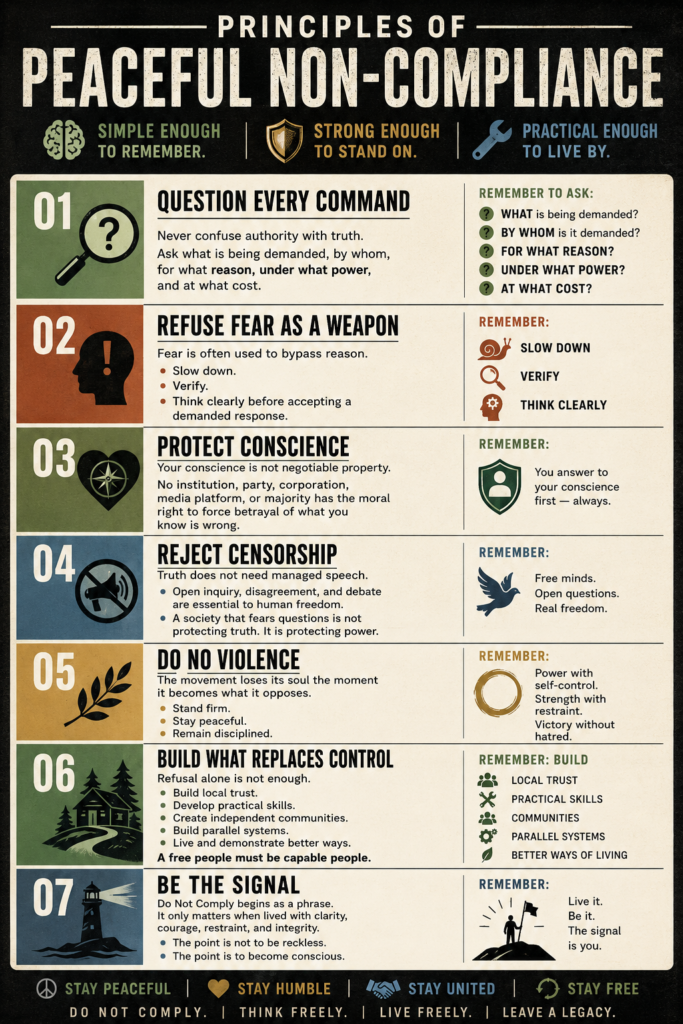
Read the seven principles in the poster
- Question every command.Ask what is being demanded, by whom, for what reason, under what authority, and at what cost.
- Refuse fear as a weapon.Slow down, verify the claim, and think clearly before accepting a demanded response.
- Protect conscience.Your judgement is your responsibility. No institution or majority can do that work for you.
- Reject censorship.Defend open inquiry, disagreement and debate. Truth must be able to withstand questions.
- Do no violence.Stand firm, stay peaceful and remain disciplined. Reject intimidation and hatred.
- Build what replaces control.Develop practical skills, local trust, supportive communities and better ways of living.
- Be the signal.Let your conduct demonstrate clarity, courage, restraint and integrity.
Pause. Ask. Think.
The first act of sovereignty is the discipline to examine what you have been told. Guard your mind, keep your conscience, and choose your actions with care.