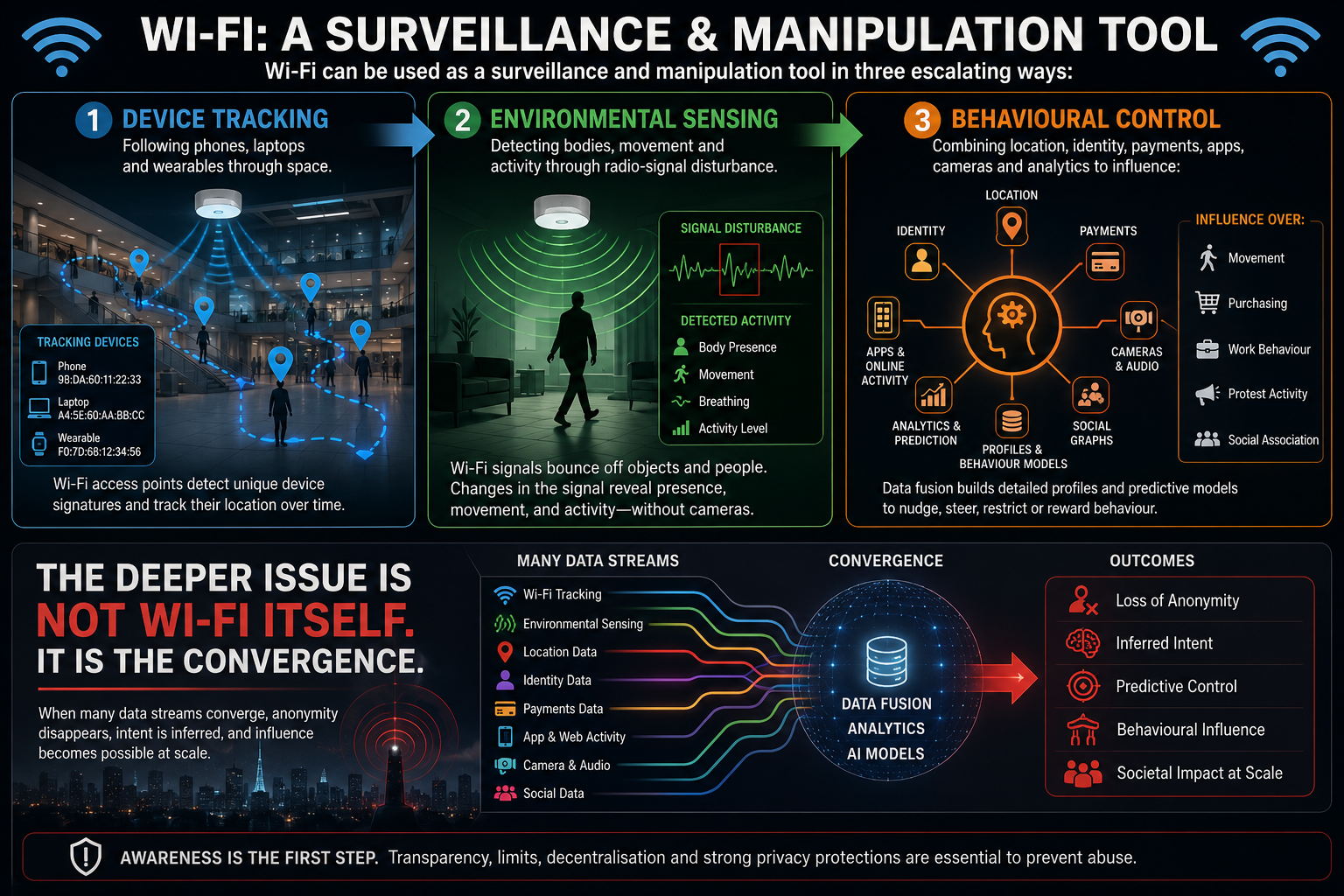
Wi-Fi can, is and will increasingly be used as a surveillance and manipulation tool in three escalating ways:
- Device tracking.
- Environmental sensing.
- Behavioural control.
The real issue is the conversion of ordinary environments into machine-readable behavioural territory.
Video Credit: Cyb3rMaddy @ the Cyb3rMaddy – YouTube Channel
Wi-Fi as a Surveillance Tool
A dark civic explanation and citizen’s guide for understanding how ordinary wireless infrastructure can become a system of tracking, sensing, behavioural mapping and quiet control.
Convenience is the Cover Story
Wi-Fi is sold as convenience. Free internet. Smart homes. Faster payments. Seamless shopping. Connected cities. Safer workplaces. Efficient transport. Better customer experience.
Beneath that friendly language sits a harder truth: every phone, laptop, router, watch, smart TV, camera, speaker, printer, car and “smart” appliance adds to an invisible radio field. That field can connect people. It can also watch them.
Not always with cameras. Not always with permission. Not always with clear signs. Not always with your name attached at first.
But enough to build patterns.
- Where you go.
- How long you stay.
- Who you stand near.
- Which room you are in.
- When your house is empty.
- When a crowd forms.
- When workers leave their desks.
- When shoppers hesitate.
- When citizens gather.
The Simple Version
Wi-Fi can be used to locate, measure, classify and influence human behaviour.
| Function | What It Means |
|---|---|
| Track devices | Your phone or laptop can reveal presence and movement. |
| Map behaviour | Shops, workplaces and public spaces can analyse where people go. |
| Detect bodies | Wi-Fi signals can sense movement and occupancy in some environments. |
| Build routines | Repeated patterns can reveal work, sleep, shopping and social habits. |
| Identify groups | Crowds, meetings, protests and associations can be mapped. |
| Influence decisions | Data can shape what people see, where they move, and how they behave. |
The Old Model
“Put a camera on the wall.”
The New Model
“Turn the entire environment into a sensor.”
1. The Invisible Net
Most people think surveillance looks like a camera. That is outdated.
A modern surveillance environment can be built from ordinary infrastructure:
Wi-Fi Routers
Local radio infrastructure that can support tracking, connection logs and environmental sensing.
Bluetooth Beacons
Short-range signals used for proximity detection, retail analytics and location-based triggers.
Smart Lights
Networked devices that can become part of a larger smart-building data layer.
Smart Meters
Energy systems that can expose patterns of household activity.
Phones
Personal devices that constantly scan, connect, update and communicate.
CCTV
Visual surveillance that can be combined with device and movement data.
Payment Terminals
Transaction points that can connect identity, place, time and behaviour.
Loyalty Apps
Consumer tracking systems disguised as rewards and convenience.
Access Cards
Workplace and building systems that record movement and presence.
Each one seems harmless alone. Together, they form a behavioural map.
2. Device Tracking: Your Phone as a Beacon
Your phone constantly searches, connects, checks, updates and communicates.
Even when you are not thinking about Wi-Fi, your device may still be interacting with nearby networks. Modern phones have stronger privacy features than older ones, but the basic risk remains: devices can still leak patterns.
A shopping centre, airport, workplace, campus or city system may be able to estimate:
- When you arrived.
- Where you moved.
- How long you stayed.
- Whether you returned.
- Whether you were alone.
- Whether you passed certain areas.
- Whether you joined a crowd.
- Whether you came back another day.
3. Wi-Fi Sensing: When the Room Itself Watches
Wi-Fi signals bounce off bodies, walls, furniture and movement. That means Wi-Fi can potentially be used to detect presence, motion, room occupancy, walking, sitting, falling, gestures, breathing-like micro-movements and movement through or behind some barriers.
This is not magic. It is signal analysis. When a human body enters a radio field, the field changes. With enough sensors, processing and training data, those changes can become information.
That turns Wi-Fi from a network into a low-visibility sensor system.
Not every router is doing this. Not every claim is proven in every real-world environment. Accuracy varies. But the direction is clear: the infrastructure for passive environmental surveillance is being normalised inside homes, shops, workplaces and cities.
4. Retail: Manipulation Disguised as Convenience
In a shop, Wi-Fi analytics can measure where customers walk, which aisles they avoid, where they hesitate, what displays hold attention, how long they wait, whether they return, whether they respond to alerts and whether they are likely to buy.
That data can then be combined with:
- Loyalty cards.
- Payment records.
- App accounts.
- Facial recognition.
- CCTV.
- Online browsing history.
- Location data.
The purpose is not only to understand behaviour. It is to shape behaviour.
The system does not need to know your soul. It only needs to know which trigger increases your probability of compliance.
5. Workplace: Productivity Becomes Obedience
Workplaces are fertile ground for Wi-Fi control.
Corporate systems can already log:
- When a device connects.
- Which access point it connects to.
- What area of the building it is in.
- How long someone stays in one place.
- Movement between floors.
- After-hours presence.
- Meeting room occupancy.
- Proximity between workers.
The Sales Language
Safety, efficiency, cybersecurity, occupancy planning, asset management and flexible-work analytics.
The Darker Use
Break monitoring, informal meeting tracking, productivity scoring, disciplinary evidence and psychological pressure to remain visible.
6. Home: The Private Refuge Becomes Machine-Readable
The home used to be the line. Outside was public. Inside was private.
Smart infrastructure weakens that line. A home filled with routers, mesh systems, smart TVs, voice assistants, cameras, appliances, phones and sensors can reveal:
- When people wake.
- When people sleep.
- Which rooms are occupied.
- When the house is empty.
- Whether someone lives alone.
- How often visitors come.
- Child movement patterns.
- Elder movement patterns.
- Work-from-home routines.
- Domestic habits.
- Stress-adjacent behaviour if combined with other sensors.
Some uses are beneficial. Fall detection for the elderly can be legitimate. Energy efficiency may be legitimate. Security may be legitimate.
- First: convenience.
- Then: safety.
- Then: insurance.
- Then: compliance.
- Then: enforcement.
7. Public Space: Crowd Control Without Visible Force
Wi-Fi can be used to estimate crowd size, crowd movement, dwell time, repeat attendance, group clustering, entry and exit patterns, response to announcements and pressure points in public spaces.
Around protests, meetings, political events, churches, legal offices, union gatherings or medical clinics, this becomes dangerous.
Even if individual names are not attached immediately, the data can still show:
- Who was there repeatedly.
- Which devices moved together.
- Who arrived with whom.
- Who left with whom.
- Which groups formed.
- Which locations acted as organising points.
8. The Real Danger: Linking Systems Together
Wi-Fi alone is concerning. Wi-Fi combined with everything else is the true threat.
- Your device appears in a location.
- You connect to public Wi-Fi.
- You accept terms and conditions.
- You enter an email, phone number or social login.
- CCTV sees your face.
- You pay by card.
- Your loyalty account records the purchase.
- Your phone apps log location.
- The system links the event to your profile.
- Future behaviour becomes predictable.
9. Behavioural Control: The Quiet Weapon
Surveillance is not the final purpose. Surveillance is the measurement layer. The final purpose is intervention.
The system observes, classifies, predicts and then changes the environment around you.
Prices
What price you see may change based on profile or context.
Ads
What message reaches you can be triggered by location and behaviour.
Access
Doors, services and permissions can become conditional.
Security
You may be watched, delayed, flagged or treated differently.
Employment
Workplace movement can become disciplinary data.
Insurance
Behavioural inference can influence risk assessment and pricing.
Old Control
“You are forbidden.”
New Control
“The system has decided your access is limited.”
No debate. No judge. No visible accuser. Just friction.
10. The Control Formula
Wi-Fi surveillance fits into a broader pattern.
1. Detect
Who or what is present?
2. Identify
Is this the same person, device or body as before?
3. Classify
Are they a customer, worker, protester, patient, organiser, debtor, dissident or risk?
4. Predict
What are they likely to do next?
5. Influence
What pressure, message, barrier or incentive will change their behaviour?
6. Normalise
Make the system feel ordinary until resistance seems unreasonable.
11. Real, Emerging, Exaggerated
A serious citizen movement must avoid sloppy claims. The grounded truth is already serious enough.
Real Now
- Device tracking.
- Public Wi-Fi identification.
- Retail foot-traffic analytics.
- Workplace network monitoring.
- Location-based profiling.
- Crowd-density analysis.
- Smart-home data collection.
- Combining Wi-Fi data with apps, payments and CCTV.
Emerging
- Wi-Fi sensing as a mainstream feature.
- Device-free human presence detection.
- Activity recognition.
- Room occupancy monitoring.
- Gesture and breathing-related inference.
- More advanced smart-building surveillance.
Needs Caution
- Claims that every router is already a perfect spy device.
- Claims of universal through-wall identification.
- Claims that Wi-Fi can read thoughts.
- Claims that all Wi-Fi sensing works accurately in all environments.
12. Citizen’s Guide: How to Reduce Exposure
No single step makes a person invisible. The aim is to reduce unnecessary data leakage.
Device Habits
| Action | Why It Matters |
|---|---|
| Turn off Wi-Fi when not needed | Reduces passive scanning and connection logs. |
| Disable auto-join for public networks | Prevents silent reconnection. |
| Use mobile data instead of public Wi-Fi when privacy matters | Avoids local network logging. |
| Avoid captive portals where possible | Reduces identity linking. |
| Do not sign into free Wi-Fi with social accounts | Prevents easy profile matching. |
| Keep phone software updated | Maintains modern privacy protections. |
| Use MAC randomisation | Reduces stable device tracking. |
| Review location permissions | Stops apps from enriching your movement profile. |
In Shops and Public Spaces
- Avoid unnecessary store apps.
- Avoid loyalty programs when privacy matters.
- Pay with cash where lawful and practical.
- Be cautious with QR codes.
- Do not trade identity for “free Wi-Fi.”
- Assume large venues may use movement analytics.
- Treat “customer experience” language critically.
At Work
- Assume corporate Wi-Fi can log connection time and approximate location.
- Use employer devices only for employer activity.
- Do not organise sensitive personal matters on workplace networks.
- Ask whether workplace monitoring policies disclose Wi-Fi or location tracking.
- Push for transparency around surveillance, retention and disciplinary use.
At Home
- Remove smart devices you do not need.
- Turn off unused IoT features.
- Change default router passwords.
- Keep router firmware updated.
- Use guest networks for smart devices.
- Prefer wired connections where practical.
- Avoid placing unnecessary smart devices in bedrooms or private areas.
- Be cautious with “free” smart-home features that require cloud accounts.
13. What Citizens Should Demand
A free society should not need to guess whether its environment is watching.
- Clear public signage where Wi-Fi analytics or sensing is used.
- Plain-language disclosure of what is collected.
- Strict limits on data retention.
- No sale of Wi-Fi-derived behavioural data.
- No covert biometric-like identification.
- No protest, union, medical, legal or religious tracking without strict warrant controls.
- Independent audits of smart-city surveillance systems.
- Public disclosure of government contracts with analytics vendors.
- Opt-out options where possible.
- No use of workplace Wi-Fi data for discipline without explicit policy and legal safeguards.
- Bans on combining Wi-Fi data with facial recognition, payments or loyalty data without meaningful consent.
Technology must serve the citizen. The citizen must not become livestock for the system.
14. A Sharper Public Message
In the wrong hands, routers become sensors, shops become behavioural labs, workplaces become compliance cages, homes become readable environments, and public spaces become crowd-control dashboards.
This is not about rejecting technology. It is about refusing invisible control.
A free citizen has the right to move, meet, speak, work, shop and live without being silently profiled by every signal in the room.
15. Final Statement
Wi-Fi surveillance is the perfect modern control tool because it does not look like control.
- It looks like convenience.
- It looks like safety.
- It looks like efficiency.
- It looks like progress.
But when every device becomes a beacon, every room becomes a sensor, every shop becomes a behavioural experiment, every workplace becomes a compliance grid, and every public gathering becomes a data event, the citizen is no longer simply living in society.
The Line Is Clear
- We do not reject technology.
- We reject invisible coercion.
- We reject behavioural manipulation.
- We reject surveillance without consent.
- We reject a future where human movement, association and private life are converted into data for control.
Do not comply with blind convenience.
Do not trade privacy for frictionless access.
Do not let the invisible net become normal.