The System: Credit, Collateral, Debt and Control in Australia
1. The Basic Premise
Australia is not mainly a government-debt civilisation.
It is a household-debt civilisation secured against residential land.
That is the key.
Most people are taught to think the economy runs on work, wages, savings, taxes and government spending. That is only the surface layer. Beneath it sits the machinery:
Banks create credit.
Credit flows into housing.
Housing prices rise.
Rising housing values create collateral.
Collateral allows more borrowing.
More borrowing pushes asset prices higher.
That is the system.
It is not a random accident. It is a structural loop.
Credit → Asset → Collateral → More Credit
This does not mean every borrower becomes wealthy. It means the rules favour people who already have access to assets, creditworthiness, time, buffers and financial literacy. Those outside the asset loop are left chasing wages, rent, compliance and survival.
2. The System Is Not Broken
The usual political narrative says the system is failing. That is partly wrong.
For ordinary people, the system may feel broken. Housing feels unaffordable. Wages feel weak. Debt feels permanent. Rent feels punitive. Inflation eats purchasing power. Tax feels unavoidable.
But from the perspective of banks, asset holders, large institutions and governments dependent on revenue, the system is doing what it was built to do.
It converts the population’s future labour into present credit.
It converts land into collateral.
It converts homes into financial instruments.
It converts household stability into bankable cashflow.
It converts ordinary citizens into long-term debt-servicing units.
That is why “the system is not broken; it is working as designed”
3. The Recent Past: Rescue at the Top
During major crises, the public is told that everyone must tighten up, be responsible and carry the burden.
But the institutional layer gets treated differently.
During the Global Financial Crisis, Australia avoided a dramatic banking collapse, but the public balance sheet was effectively placed behind the banking system through guarantees and system-level support.
During COVID, the Reserve Bank of Australia’s Term Funding Facility gave banks access to very cheap funding. The RBA states that banks accessed $188 billion from the facility.
This was not ordinary household relief. It was system liquidity.
That distinction matters.
The public receives moral language: responsibility, discipline, sacrifice.
The systemically important institution is protected because its failure threatens the machinery.
That is not necessarily a conspiracy in the cartoon sense. It is actually worse in some ways: it is formal policy logic. The system protects what the system depends on.
4. The Current Situation: Housing as the Core Engine
Australia’s financial structure is deeply tied to residential property.
APRA’s December 2025 ADI data shows residential mortgage credit outstanding at approximately $2.475 trillion, up from $2.322 trillion in December 2024. New housing loans funded were $217.6 billion, up 20.9% year-on-year.
That is not a side issue. That is the spine of the Australian economy.
Housing is not just shelter anymore. It is:
collateral;
retirement planning;
bank security;
tax strategy;
political pressure point;
intergenerational gatekeeping mechanism;
the main asset class ordinary Australians are pushed toward.
This is why the system keeps producing the same result.
When credit expands, people can bid more.
When people bid more, prices rise.
When prices rise, existing owners gain equity.
When owners gain equity, they can borrow more.
When they borrow more, they can buy more assets.
Those without assets fall further behind because their wages are competing against someone else’s leverage.
That is the brutal hidden mechanism.
5. The Illusion of Equal Money
A dollar is not equal in every hand.
The poor use money for survival.
The working class use money for bills and debt service.
The middle class use money to maintain status and avoid falling.
The asset class use money, debt, tax rules and collateral as tools.
The institutional class uses balance sheets, liquidity facilities, regulation, lobbying, risk models and access to public support.
That means money is not merely “money”.
Money behaves differently depending on who holds it, what assets they control, what credit they can access, what risk they can survive, and what government will do if they fail.
Money is not equally scarce.
Access to credit, collateral and stability is scarce.
6. The Debt Trap
Debt is not automatically bad.
Debt used to acquire productive assets can create leverage.
Debt used to survive rising costs can become a trap.
Debt used for lifestyle consumption can quietly destroy a household.
The danger is not debt alone. The danger is:
debt without assets; debt without liquidity; debt without pricing power; debt without buffers; debt without understanding.
This is why two families can both owe $800,000 and be in completely different positions.
One owns a appreciating asset, has stable income, has buffers, can refinance, and has optionality.
The other is stretched to the edge, has no spare liquidity, and is one job loss, illness, rate rise or family breakdown away from collapse.
Same debt number. Completely different reality.
That is the system.
7. Why Wages Alone Cannot Win
A wage earner is paid after the structure is already in place.
The bank has already created credit.
The landlord has already priced rent.
The tax system has already taken its share.
The supermarket has already adjusted prices.
The energy provider has already billed.
The insurer has already repriced risk.
The worker receives what remains and is told to be grateful, budget harder, and stop complaining.
This is why effort alone no longer guarantees security.
The system does not reward effort alone.
It rewards ownership, collateral, creditworthiness, timing, patience and knowledge.
8. The Real Divide
The divide is not simply rich versus poor.
It is more precise than that.
The divide is between:
asset holders and non-asset holders;
collateral holders and unsecured borrowers;
those with buffers and those living exposed;
those who understand credit and those who only understand wages;
those who use debt strategically and those consumed by it.
This is why Australia can look prosperous on paper while many people feel trapped.
The country can have rising property values, profitable banks, large superannuation balances, strong tax receipts and expanding credit while ordinary families feel worse.
Both can be true.
That is the part many people miss.
A system can produce wealth and insecurity at the same time. In fact, the wealth of one layer can be structurally linked to the insecurity of another.
9. The Political Layer
Politicians usually argue over symptoms.
Housing affordability.
Inflation.
Tax.
Interest rates.
Cost of living.
Bank profits.
Rental stress.
But the deeper issue is the design of the loop itself.
If housing is treated as the main wealth engine, politicians cannot easily make housing truly affordable without damaging the balance sheets of existing owners, banks, investors and governments.
That creates a political trap.
They say they want cheaper housing.
But they also need rising asset values, stable banks, confident consumers, stamp duty revenue, construction activity and retirement wealth.
So the public gets speeches about affordability while the machinery keeps protecting the asset base.
That is why the same problem survives every election cycle.
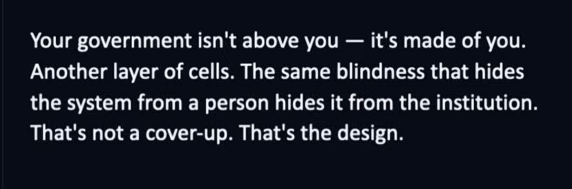
Your government isn’t above you – it’s made of you. The same blindness that hides the system from a person hides it from the institution. That’s the design.
Lehto Files May 2026
10. The Future Situation
The likely future is not necessarily a dramatic collapse.
It may be a slower separation.
A country where:
asset holders gain optionality;
renters become permanently exposed;
young people inherit position rather than earn it;
family wealth matters more than wages;
banks remain protected;
government policy manages symptoms;
debt becomes normalised as survival;
ownership becomes the dividing line between autonomy and dependence.
If the incentives continue, Australia’s future may be “a slower, harsher divide between asset-holders and non-asset-holders”.
A managed divide? Is there a possibility that Elites have engineered deliberate societal splits (race, politics, class) to keep normies fighting each other while they consolidate power.
It’s been done before …. See more on the Managed Divide page
11. The Do Not Comply Angle
In this context, Do Not Comply does not mean anything reckless.
It means refusing to remain ignorant inside a system that profits from ignorance.
It means:
do not confuse debt with wealth;
do not confuse asset inflation with intelligence;
do not confuse bank approval with financial safety;
do not assume government rescue applies to you;
do not believe the surface narrative without checking the machinery;
do not become financially obedient by default.
Citizen-level awareness includes not using debt for lifestyle, not borrowing without buffers, and learning how banks, credit, tax, inflation and collateral actually work.
Literacy has historically been used as a form of societal control. Today … more than ever … Literacy may now be used as resistance.
donotcomply.au
12. The Hardest Truth
The system does not need people to understand it.
It only needs them to participate.
Borrow.
Work.
Pay.
Rent.
Refinance.
Consume.
Vote emotionally.
Argue over symptoms.
Blame each other.
Miss the mechanism.
Sound familiar?
The person who understands the mechanism has a chance to step back from the trap.
The person who does not understand it remains blindly manipulated inside their model … their system.
That is why all this matters.
Because the first act of non-compliance is not rebellion. It is seeing the machine clearly.