Do Not Comply
When the rules change,who gets to succeed?
A market can put a price on your skills. It cannot settle your worth.
Take the qualities you are proudest of. Now imagine a different decade, a different country, or a different economy. Would those same qualities earn you the same security, respect or income?
Then reconsider the judgement.
One success story cannot tell us who had a fair chance.
Someone who escapes poverty may have shown extraordinary persistence, skill and courage. That achievement deserves recognition. It does not establish that everyone who worked just as hard had the same opportunity.
The story of the person who made it rarely tells us enough about those who did not: the capable worker whose health failed, the carer who could not relocate, the business owner whose biggest customer collapsed, or the graduate who entered a profession during a downturn.
OECD research documents persistent barriers to mobility across earnings, education, occupation and health, both between generations and during a person’s lifetime. The report also identifies policies that can improve mobility. Circumstances matter; they are not beyond our capacity to change. OECD: A Broken Social Elevator?
Effort can influence an outcome without being the only thing that determines it.
Hold the person constant.
Change one condition.
These are thought experiments, not accounts of particular people. Open each example and consider what the outcome would actually tell you.
Change the financial cushion.
Two equally capable people make the same careful attempt to start a business. Both suffer the same loss. One has savings and family support, so they can try again. The other must immediately return to whatever paid work is available to keep a roof overhead.
If the person with the financial cushion succeeds on their second attempt, does that show greater determination—or more room to survive a setback?
Change the decade.
Imagine people with the same aptitude and persistence entering the same profession twenty years apart. One arrives as demand expands. The other arrives when new technology makes many familiar tasks cheaper to perform.
If their earnings diverge, how much of the difference belongs to character—and how much to timing?
Change what the community needs.
In one setting, financial expertise is highly rewarded. During a prolonged power failure, practical repair skills, local knowledge and the ability to care for others may become urgent. The people have not acquired new personalities overnight. The circumstances have changed.
Why treat the hierarchy produced by one setting as a permanent ranking of people?
AI makes the question harder to ignore.
A person can spend years developing a skill, only to face a change in what employers need or will pay for. Their training has not vanished. Their effort has not become imaginary. The economic setting has shifted.
AI can also help less experienced workers perform some tasks more effectively. A study of customer-support agents found larger productivity gains from AI assistance among less experienced workers and those with lower prior performance. That is evidence from a particular workplace, not a prediction for every occupation. Brynjolfsson, Li & Raymond: Generative AI at Work
The distribution question remains: who owns the tools, who receives training, who captures the gains, and who carries the cost of adapting?
If someone’s bargaining power falls while their diligence remains, should we describe that as a failure of character?
Who can afford to take a chance—and try again?
Capitalism gives private ownership, markets and profit a central role. But actual economies also rely on public institutions and rules. Access to assets, credit, education and support affects which opportunities a person can pursue and how much risk they can survive.
Commercial banks typically create a deposit when they make a loan; repayment of principal typically removes deposit money. Bank lending is constrained by factors including capital, liquidity and profitability. Non-bank lending, government budgets and central-bank money creation are distinct activities, even though they interact. RBA: Money in the Australian Economy
Those mechanisms alone do not settle whether an arrangement is fair. The questions are who can obtain finance, on what terms, and whose interests shape the rules. A system can offer formally equal permission to compete while people have radically different capacity to bear a loss.
The Australian housing example
A rise in house prices can increase an existing owner’s equity while raising the entry price for someone without a home. The same market movement can widen one person’s options and narrow another’s.
The RBA’s March 2026 assessment identifies household indebtedness as a longstanding domestic vulnerability. That supports scrutiny of financial resilience; it does not make a property crash inevitable. RBA: Financial Stability Assessment
An economy can reach a balance that leaves people behind.
An equilibrium describes a situation in which decisions fit together under a model’s assumptions. Establishing that such a position exists does not, by itself, show that an economy will move toward it—or that its distribution of resources is fair.
Kenneth Arrow made the distribution point explicitly in his Nobel lecture: economic efficiency does not establish distributive justice. A model can describe an efficient allocation while allowing very unequal living conditions. Arrow’s 1972 lecture (PDF)
| Approach | What it helps examine | What to keep separate |
|---|---|---|
| Equilibrium analysis | How prices, choices and available resources can fit together. | A consistent allocation does not establish equal opportunity or a just distribution. |
| Financial-friction models | How borrowing constraints can amplify economic changes. | Mainstream economics also models finance and feedback effects. Financial accelerator research |
| Minsky’s hypothesis | How prolonged confidence can encourage fragile financing. | A mechanism for instability is not proof that every crisis is inevitable or deliberately engineered. |
On a narrow screen, scroll the comparison sideways. These are different analytical lenses, not a complete classification of economics.
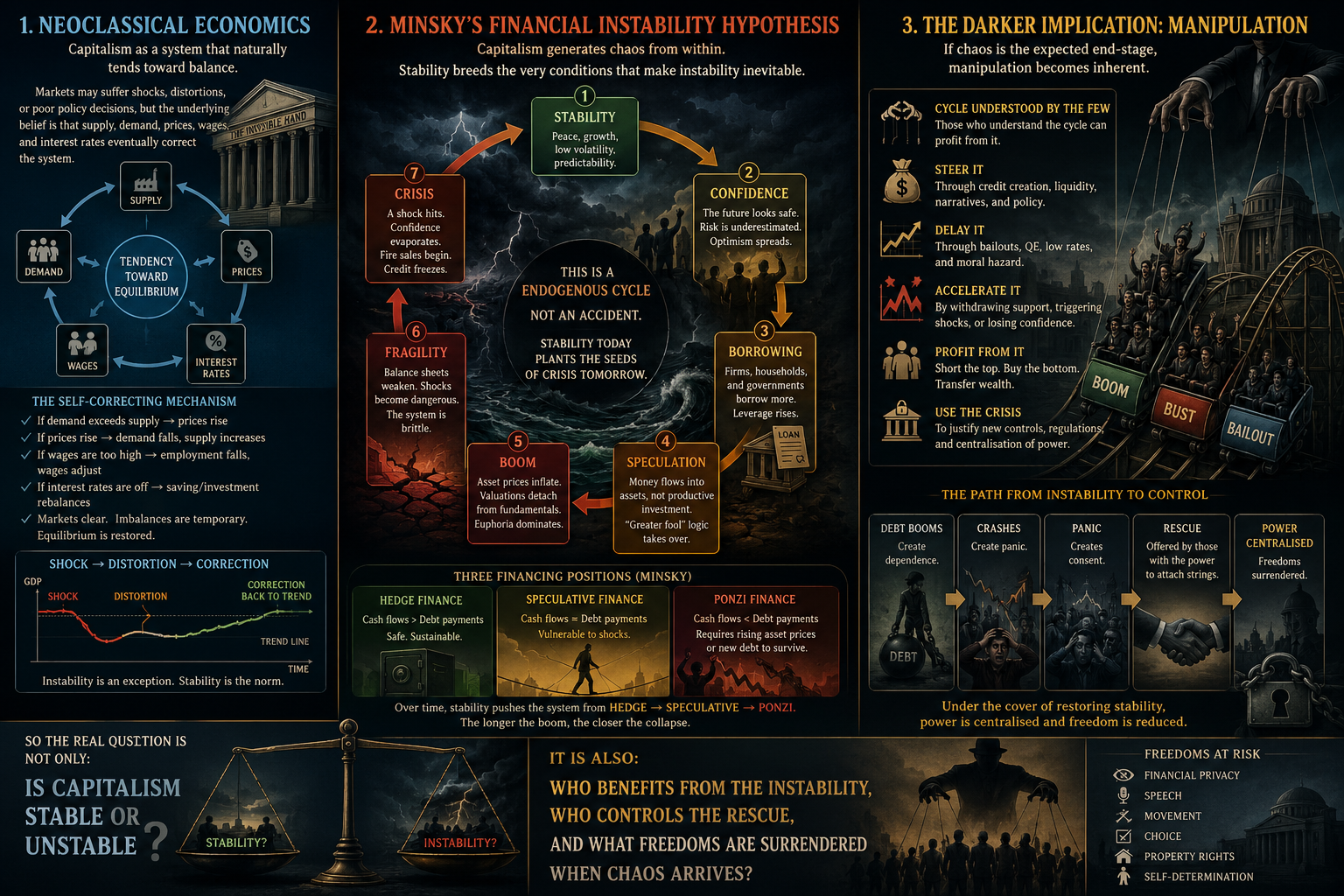
Minsky: confidence can change the risk people accept.
Hyman Minsky argued that sustained prosperity can encourage a shift toward increasingly fragile financing. Apparent safety changes behaviour. This is a possible source of instability inside the financial system, rather than a timetable for an unavoidable crash. Minsky’s original paper (1992, PDF)
- Confidence grows
- Borrowing becomes easier
- Commitments stretch
- Resilience can weaken
- Hedge finance
- Operating cash flow can cover the required principal and interest payments.
- Speculative finance
- Cash flow covers interest, but maturing principal needs refinancing.
- Ponzi finance
- Operating cash flow cannot cover even the interest due; further borrowing or asset sales are needed.
These are financing positions, not compulsory stages every borrower passes through. “Ponzi finance” here does not necessarily mean a fraudulent Ponzi scheme.
Who receives protection when risk becomes loss?
A financial crisis can harm people who did not create it. A rescue then raises decisions about whose losses receive protection, what conditions are imposed and who has a voice in the process.
The right response is to examine those decisions: who benefits, who pays, who gains influence, and whether the rules become more accountable afterward. Someone profiting from instability is a reason to investigate incentives and conduct; it is not, on its own, evidence that they planned the crisis.
For this essay, the test is straightforward: a claim that people must accept the consequences of their choices should be applied consistently, including to powerful institutions.
A society needs more than one kind of competence.
Technical skill, practical repair, care, creativity, organisation and local knowledge answer different needs. The mix that commands the highest income in one setting is not a permanent catalogue of everything a community needs.
People also change during their lives. An illness, a caring responsibility, migration, new technology or the closure of a local industry can transform the choices available to someone who was previously secure.
Think of diversity as preserving options. As an analogy with ecological resilience, a variety of human capabilities gives a community more ways to respond to changing conditions. This is a way to think about social resilience, not a biological explanation for inequality.
That is a reason to leave room for different approaches, to test institutions against their consequences, and to change arrangements that repeatedly exclude people. No economic label guarantees fairness. Every arrangement needs scrutiny.
We can recognise achievement without turning hardship into a verdict.
A person’s success can be deserved. It does not follow that another person’s hardship is. Before calling someone a failure, ask what they were trying to do, what resources they had, what happened to them, and whether the conditions would have favoured you.
The point is to judge an economy by the opportunities, security and dignity it offers across different lives—not solely by the stories of its winners.
If you did not know which life you would be born into, which rules would you consider fair?
Read the evidence. Question the interpretation.
This is an essay about fairness, supported by the research below. Its thought experiments and moral conclusions are the site’s argument; they are not empirical findings or claims that all economists agree.
- OECD · A Broken Social Elevator? (2018)Opportunity and mobility across generations and during a lifetime.
- ILO · Generative AI and jobs: A 2025 updateOccupational exposure and the distinction between transformation and replacement.
- Brynjolfsson, Li & Raymond · Generative AI at WorkA study of AI assistance in customer support; NBER working paper, 2023.
- RBA · Money in the Australian Economy (2018)Bank deposits, lending and the different forms of money.
- RBA · Financial Stability Assessment, March 2026Household debt and financial vulnerability in Australia.
- Kenneth Arrow · Nobel lecture, 1972 (PDF)General equilibrium, efficiency and the separate question of distributive justice.
- Bernanke, Gertler & Gilchrist · The Financial AcceleratorA general equilibrium framework that incorporates financial amplification; 1998.
- Hyman Minsky · The Financial Instability Hypothesis (PDF)Original working paper, May 1992; see the financing positions on pages 7–8.