AI technology stack
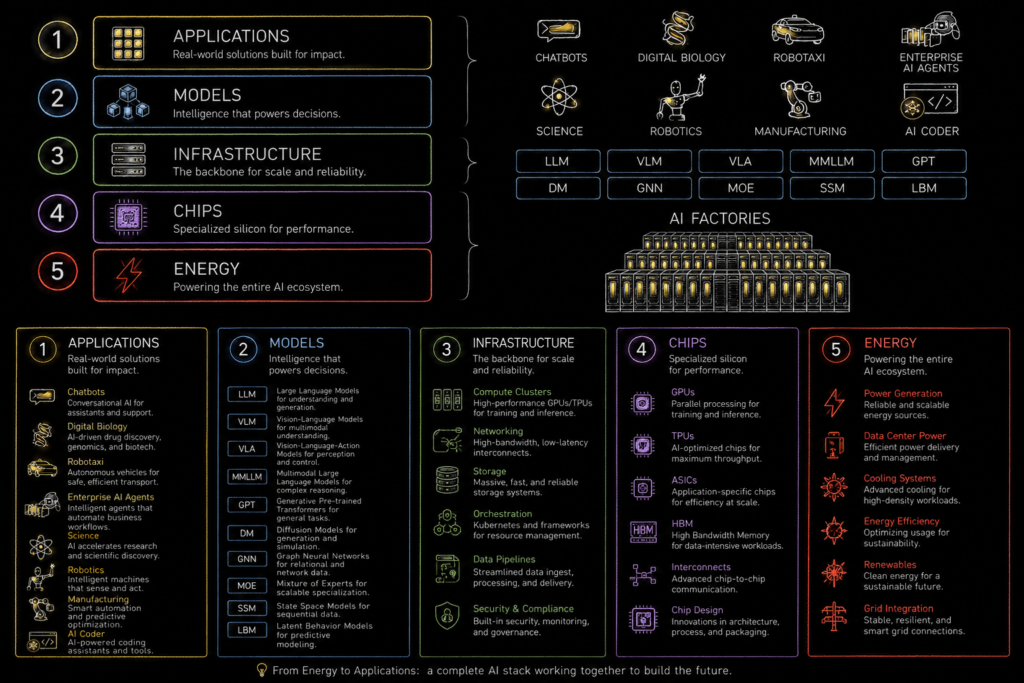
AI is not just software. It is a full industrial system requiring data centres, semiconductors, power infrastructure, cooling, logistics, security, and governance.
The bottom layer — Energy — is highlighted in red because it is the physical foundation. Without sufficient power, cooling, and grid capacity, the upper layers cannot scale.
A worldwide comparison in the race to energy / AI dominance is expanded upon at the end … and there is a clear winner (note: …. it’s not us)
1. Applications — the visible AI economy
This is the top layer: where users, businesses, governments, and industries actually experience AI.
The image lists:
| Application | What it represents |
|---|---|
| Chatbots | Consumer and enterprise assistants, customer service, research, writing, planning |
| Digital biology | Drug discovery, protein design, genomics, synthetic biology, personalised medicine |
| Robotaxi | Autonomous driving, fleet logistics, urban transport automation |
| Enterprise AI agents | AI workers performing admin, compliance, reporting, scheduling, finance, HR, legal review |
| Science | AI-assisted discovery in physics, chemistry, materials science, climate modelling |
| Robotics | Machines that see, interpret, decide, and act in physical space |
| Manufacturing | Smart factories, predictive maintenance, quality control, automated supply chains |
| AI coder | Code generation, debugging, software architecture, app creation, cyber testing |
Important point
Applications are the commercial tip of the spear. They are what everyone sees, but they depend on everything below them.
A chatbot may look lightweight, but behind it can sit:
model weights → GPU clusters → data centres → chips → cooling → electricity → grid infrastructureSo the apparent “magic” of AI is actually a large physical machine hidden behind a clean interface.
2. Models — the intelligence layer
The second layer shows different AI model families. This is where raw compute becomes “capability”.
| Model type | Meaning |
|---|---|
| LLM | Large Language Model. Handles text, reasoning, summarisation, planning, dialogue |
| VLM | Vision-Language Model. Understands images and text together |
| VLA | Vision-Language-Action model. Connects perception to physical action, important for robotics |
| MLLM | Multimodal Large Language Model. Works across text, image, audio, video, sensor data |
| GPT | Generative Pre-trained Transformer-style model |
| DM | Diffusion Model. Used heavily for image, video, design, and generative media |
| GNN | Graph Neural Network. Useful for molecules, networks, relationships, materials, biology |
| MoE | Mixture of Experts. Large model architecture where only parts activate for a given task |
| SSM | State Space Model. Efficient sequence modelling; possible alternative/complement to transformers |
| LBM | Likely “Large Behaviour Model” or similar; behaviour prediction/action modelling |
Key insight
Different AI applications need different model structures.
A chatbot, a protein-design tool, a robot arm, and a robotaxi are not just “one AI wearing different clothes”. They require different combinations of:
language
vision
physics
memory
planning
safety
sensor fusion
real-time decision-making
The future trend is toward multimodal, agentic, embodied AI — systems that can read, see, listen, speak, plan, operate tools, and eventually control machines.
3. Infrastructure — the AI factory layer
The image shows AI factories in the centre. This is an important phrase.
An AI factory is not just a normal data centre. It is closer to a specialised industrial plant that converts electricity into intelligence.
It contains:
| Infrastructure element | Purpose |
|---|---|
| Compute clusters | Thousands of GPUs/TPUs/accelerators working together |
| Networking | Ultra-fast chip-to-chip and server-to-server connections |
| Storage | Data, model weights, training logs, video, synthetic datasets |
| Orchestration | Software that allocates compute, deploys models, manages workloads |
| Data pipelines | Collecting, cleaning, labelling, filtering, and distributing training data |
| Security and compliance | Protecting intellectual property, user data, model outputs, and national capability |
Hidden importance
Infrastructure is the layer where AI stops being abstract and becomes heavy industry.
The important bottlenecks here are:
land
power connection
cooling
water access
grid approval
GPU supply
networking hardware
data sovereignty
cybersecurity
This is why AI is increasingly linked with geopolitics. A country may have excellent researchers, but without infrastructure, it cannot build sovereign AI at scale.
4. Chips — the computation layer
The chips layer is where mathematical work is physically performed.
The image lists:
| Chip component | Role |
|---|---|
| GPUs | Main AI workhorses for training and inference |
| TPUs | Tensor-focused accelerators, often used for large AI workloads |
| ASICs | Custom chips designed for narrow high-efficiency tasks |
| HBM | High Bandwidth Memory; critical for large models |
| Interconnects | Links that allow chips to communicate rapidly |
| Chip design | Architecture, packaging, fabrication, and optimisation |
Critical point
AI is not limited only by “how many chips” exist. It is limited by the whole chip ecosystem:
advanced lithography
wafer fabrication
packaging
HBM memory
substrates
cooling
firmware
drivers
networking
power delivery
A modern AI chip is only useful when surrounded by the right memory, networking, cooling, and software.
Strategic implication
This is why the AI race is tied to:
Taiwan
ASML lithography
NVIDIA GPUs
TSMC fabrication
Samsung / SK Hynix memory
US export controls
Chinese domestic chip efforts
The chip layer is where AI becomes a national-security issue.
5. Energy — the foundation layer
The red-highlighted bottom layer is the most important part of the image.
Energy powers everything above it:
Energy → Chips → Infrastructure → Models → ApplicationsThe image breaks energy into six subcategories:
| Energy subcategory | Meaning |
|---|---|
| Power generation | Producing enough electricity from nuclear, gas, coal, hydro, solar, wind, geothermal |
| Data-centre power | Delivering high-density electricity safely and continuously into AI factories |
| Cooling systems | Removing heat from chips, racks, and buildings |
| Energy efficiency | Reducing electricity needed per calculation or per AI task |
| Renewables | Solar, wind, hydro, batteries, green hydrogen, firmed clean energy |
| Grid integration | Transmission lines, substations, smart grids, storage, demand response |
Why this matters
Every AI calculation consumes energy. Training large models, running millions of AI queries, rendering video, operating robotics, and powering autonomous systems all require electricity.
The AI stack therefore becomes constrained by:
available megawatts
grid connection timelines
electricity price
cooling capacity
water availability
power reliability
carbon constraints
local politics
This is the real hidden bottleneck.
A company may have the best model design and billions in capital, but if it cannot secure enough power, it cannot scale.
The full-system logic
The image is really showing a dependency chain:
Applications need models.
Models need infrastructure.
Infrastructure needs chips.
Chips need energy.
Energy needs generation, grids, cooling, and storage.
Or, more bluntly:
AI is not floating in the cloud.
It is grounded in silicon, steel, copper, water, land, and electricity.
That is the deeper meaning of the diagram.
The strongest strategic takeaways
1. AI is becoming industrialised
The phrase AI factories is important. It suggests that intelligence is becoming a manufactured output.
Traditional factories turn:
raw materials + energy → physical goodsAI factories turn:
data + chips + energy → intelligence / prediction / automationThat is a major civilisational shift.
2. Energy becomes a national AI advantage
The countries best positioned for AI will not only be those with software talent. They will be those with:
cheap electricity
stable grids
nuclear/hydro/gas/renewables
data-centre land
chip access
sovereign cloud capacity
technical workforce
This means nations like the United States, China, Canada, France, India, South Korea, and parts of the Gulf could become highly important in AI infrastructure.
3. The AI stack feeds back into itself
This is not a one-way ladder. AI applications can improve the lower layers.
For example:
| AI application | Lower-layer improvement |
|---|---|
| AI science | Better batteries, materials, cooling fluids, superconductors |
| AI coding | Better infrastructure software |
| AI chip design | More efficient semiconductors |
| AI robotics | Automated factories and chip production |
| AI grid management | Better energy forecasting and load balancing |
| AI biology | Better bio-manufacturing and medical discovery |
So the stack becomes a feedback loop:
AI improves infrastructure → infrastructure improves AI → AI improves energy → energy scales AIThat feedback loop is where acceleration happens.
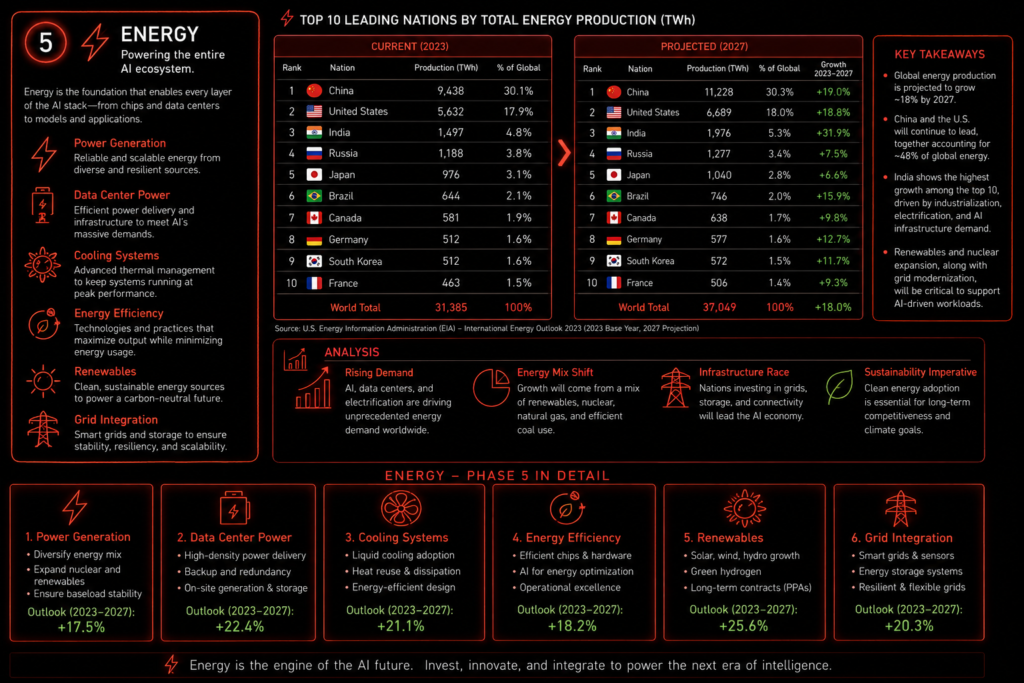
Energy
Energy phase only — why it matters
In the AI stack, energy is not just another support layer. It is the physical constraint underneath the whole system.
AI factories need:
| Energy requirement | Why it matters |
| Reliable baseload | Training clusters and inference systems need continuous uptime. |
| High peak capacity | Data centres can create sudden local grid strain. |
| Low-cost electricity | Power cost becomes a strategic advantage. |
| Cooling power | Every watt used by chips becomes heat that must be removed. |
| Grid connection speed | A data centre can be delayed years if transmission is unavailable. |
| Energy sovereignty | Nations with domestic power generation have more AI independence. |
| Clean energy access | Large AI companies increasingly need low-emissions power for public, regulatory, and commercial reasons. |
The International Energy Agency projects that global data-centre electricity consumption will roughly double by 2030 to around 945 TWh, growing around 15% per year from 2024 to 2030, which is more than four times faster than broader electricity demand growth.
So phase 5 is really about:
Who can power the AI factories?
Not just who can write the best model.
Top 10 AI-leading nations used for this comparison
For the “leading nations” list, I am using the Tortoise / Global AI Index 2024 top 10:
United States, China, Singapore, United Kingdom, France, South Korea, Germany, Canada, Israel, and India. The index ranks countries by AI capacity across investment, innovation, and implementation; its methodology includes 122 indicators across 83 governments.
Stanford’s 2025 AI Index supports the same broad picture: the United States remains ahead in top AI model production, while China is rapidly closing the performance gap and leads strongly in AI publications and patents.
Electricity production now vs indicative 4-year outlook
The current electricity-production figures below are from Ember/OWID-derived data as listed by country, mostly 2024 or 2025 depending on latest available national data.
The 4-year outlook is not a formal country-by-country forecast. It is an indicative estimate using IEA demand-growth guidance where available: China about 4.9% p.a., India about 6.4% p.a., United States nearly 2% p.a., EU/advanced economies around ~2% p.a., with Singapore/Israel treated as higher-pressure small-grid AI/data-centre markets at roughly ~3% p.a. where precise public generation forecasts are less clear.
| AI rank | Nation | Current electricity production | Indicative production in ~4 years | Energy advantage / constraint |
| 1 | United States | ~4,391 TWh | ~4,753 TWh | Huge gas, nuclear, renewables, and private data-centre buildout. Strongest AI ecosystem, but grid bottlenecks and data-centre load are becoming strategic constraints. |
| 2 | China | ~10,087 TWh | ~12,214 TWh | Largest electricity system on Earth. Coal still heavy, but solar, wind, hydro, nuclear, grid buildout, and manufacturing scale give China a major AI-energy advantage. |
| 3 | Singapore | ~60 TWh | ~68 TWh | Extremely advanced digital hub but physically energy-constrained. Likely dependent on imports, efficiency, regional power agreements, and selective AI/data-centre policy. |
| 4 | United Kingdom | ~293 TWh | ~311 TWh | Strong AI policy and research base, but modest generation scale. UK data-centre demand could become a serious grid-planning issue. |
| 5 | France | ~568 TWh | ~615 TWh | Major advantage: nuclear-heavy low-carbon electricity. France may be one of Europe’s strongest AI-energy candidates if grid and compute investment align. |
| 6 | South Korea | ~625 TWh | ~677 TWh | Strong chips, manufacturing, nuclear, and industrial power demand. Energy security is the issue because domestic fossil resources are limited. |
| 7 | Germany | ~497 TWh | ~538 TWh | Strong industrial and engineering base, but energy cost and post-nuclear system design remain constraints. Renewables are growing, but grid/storage/flexibility are central. |
| 8 | Canada | ~637 TWh | ~690 TWh | Very strong position: hydro, nuclear, land, cooling climate, and proximity to US AI markets. Could be a quiet AI-compute winner. |
| 9 | Israel | ~74 TWh | ~83 TWh | Strong AI/cyber talent but limited electricity scale. Gas and solar expansion matter, but geopolitical and grid-security risks are high. |
| 10 | India | ~2,030 TWh | ~2,602 TWh | Fastest growth profile among the top 10. Huge talent base and rapidly rising electricity demand. Coal remains dominant, but solar growth is strategically important. |
Critical read: who is best positioned?
Strongest energy foundations for AI
China has the biggest raw advantage because it can combine electricity scale, manufacturing, grid expansion, nuclear expansion, solar deployment, and state-directed infrastructure. Its weakness is fossil dependence, but that is being offset by enormous low-emissions buildout. IEA expects China to remain the largest contributor to global electricity-demand growth through 2030 and to add demand roughly equivalent to today’s EU electricity consumption.
United States has the deepest AI ecosystem and vast energy resources, especially gas, nuclear, renewables, and private capital. Its risk is fragmentation: grid queues, local opposition, ageing transmission, and uneven state-level energy policy.
Canada is underrated. For AI factories, Canada has hydro, nuclear potential, cold climate, land, and proximity to US technology markets. It may not lead in model development, but it is structurally attractive for compute hosting.
France is also strategically important because nuclear power gives it stable low-carbon electricity. If France can align compute, industrial policy, and grid capacity, it has one of Europe’s best energy bases for AI.
Most constrained despite AI strength
Singapore is the clearest example of an AI/data hub that lacks physical energy depth. It can lead in finance, governance, data routing, and regional AI deployment, but large-scale AI factories need land, cooling, and power. Singapore’s future likely depends on ultra-efficient compute, subsea power imports, regional partnerships, and selective high-value AI workloads.
United Kingdom has strong AI talent and policy ambition, but the energy layer is thinner than its AI ambition. UK data-centre growth is already being discussed as a serious energy-planning issue, with forecasts of major data-centre electricity growth by 2030.
Israel has exceptional AI/cyber capability but limited electricity scale and high security risk. It can dominate specialised AI, defence AI, cybersecurity, and edge systems, but not necessarily giant AI-factory infrastructure.
Fastest mover
India is the most important “rising energy + AI” case. Its AI talent base is large, and its electricity demand is forecast to grow strongly. IEA expects India’s demand to grow around 6.4% annually through 2030, with coal still the main source but solar, wind, nuclear, hydro, and gas all expanding.
Hidden angle
The AI race may split into two different races:
| Race | Winners likely to be |
| Model intelligence race | US, China, UK, France, Israel, Canada |
| AI factory / compute-energy race | China, US, Canada, France, India, possibly Nordic/EU regions |
| AI deployment race | Singapore, UAE, South Korea, UK, Germany |
| Sovereign AI race | Nations with domestic chips, domestic energy, domestic data, and domestic cloud |
The deeper reality is:
AI sovereignty = compute + chips + data + energy + law.
Energy is the part that cannot be faked with branding. It has to physically exist.